
A lot of Malaysian businesses start searching for voice over ip because monthly telco bills feel unpredictable, especially once you add multiple branches, sales teams, or a small call center. You ask for a quote, and the price looks affordable. Then the “real” costs show up later: add-on fees, hardware, setup, support, and upgrades you did not plan for.
This guide breaks down what businesses in Malaysia actually pay for a VOIP Service, including the hidden costs that affect SMEs, retail outlets, and high call volume teams. You will learn what drives monthly fees, what providers often exclude from the first quote, and how to compare plans without getting stuck in a long contract that does not fit your operations.
If you want pricing clarity first, then an AI-optimized setup with strong after-sales support, this is exactly what ITGTEL helps businesses sort out from day one.
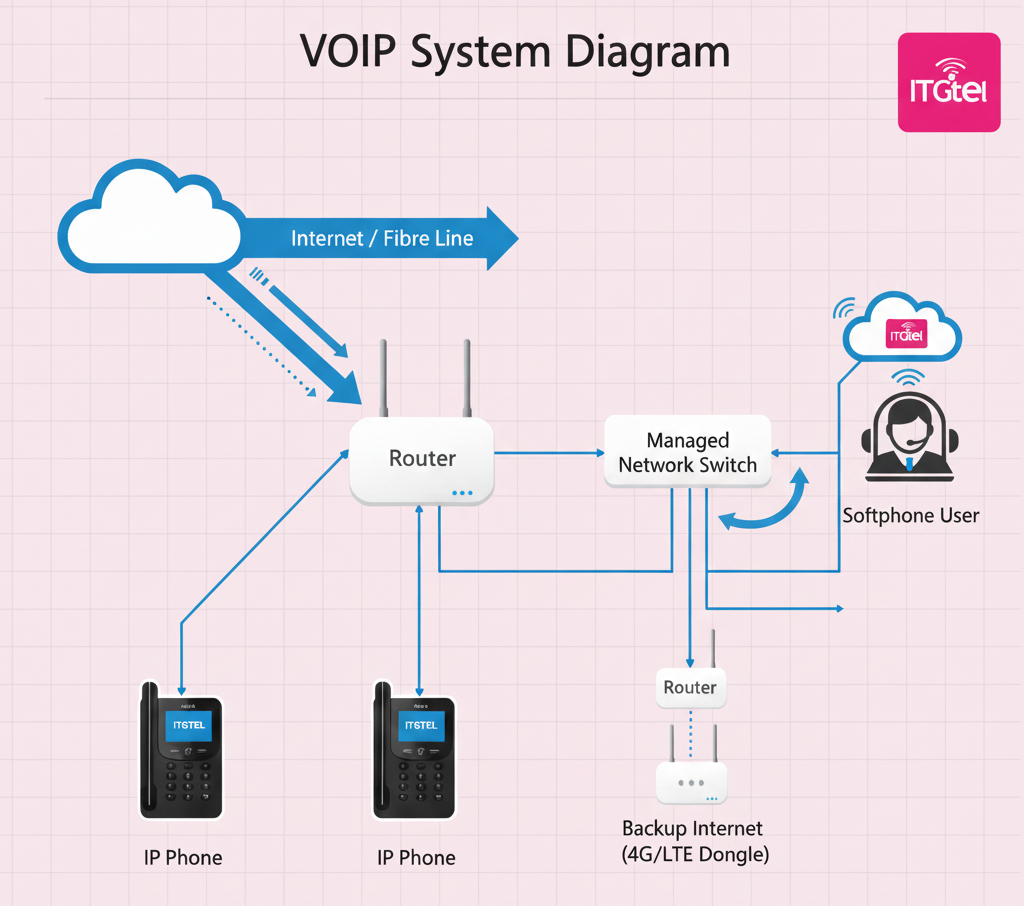
VOIP pricing is rarely “one flat number” because providers bundle different things under one label. A typical voip phone system includes user licenses, call charges, and hardware—but the way these are packaged varies wildly across the Malaysian market.
Market Pricing Overview (2026)
Based on current market offerings from major providers, here is the typical price range you can expect for a VOIP Service in Malaysia:
| Provider | Estimated Price Range (Monthly) | Focus Area |
| ITGTEL | From RM49 /user | AI-Optimized, High-Support |
| Maxis Business | RM40 – RM100+ /user | Corporate Connectivity |
| Omni (CelcomDigi) | RM60 – RM150 /user | Mobile-First Virtual Office |
| REDtone | Custom Quote Based | Enterprise Managed Services |
| CallaCloud | RM50 – RM120 /user | Cloud PBX Features |
Note: Prices vary based on features like call recording, IVR levels, and bundled minutes.
Most pricing scales by the number of extensions. While voice over ip phones can be affordable, the software license behind them is the recurring driver.
Call costs can be simple or full of conditions. Some providers offer “free minutes,” but these often exclude mobile numbers or specific prefixes.
This is where “cheap” plans become expensive. Implementation involves IVR design, queue logic testing, and porting existing numbers.
Even if the software is affordable, voip phones and quality headsets add up.
Phone over ip depends entirely on your internal network. If your router is old or your WiFi is unstable, your VOIP calls will drop.
In 2026, a “dumb” phone system is a liability.
Basic quotes often exclude:
Is a VOIP Service cheaper than traditional lines?
In almost all cases, yes. You save on hardware maintenance and international calling rates, but you must factor in the cost of a stable internet connection.
Do I need a physical VOIP Phone?
No. You can use softphones on laptops or mobiles. However, physical voip phone systems are still recommended for high-reliability areas like reception or retail counters.
Why is ITGTEL considered “AI-Optimized”?
Unlike traditional providers, ITGTEL builds its voice over ip architecture to support predictive routing and smart analytics, reducing downtime through automated network monitoring.
VOIP Service pricing in Malaysia makes sense once you break it into its real components. The hidden costs usually come from unclear scoping or underestimating the need for professional support.
If your business is comparing voice over ip providers and you want a clear, itemized cost with AI-enhanced reliability, ITGTEL can help you map your requirements and avoid surprises. A quick consultation can usually identify exactly what you need to pay for, and what you can skip.

Excellence in Telecommunication Solutions
Since 2004, ITG has provided exceptional telecommunication solutions, backed by global expertise and innovation. As a trusted PENJANA Technology Service Provider, we deliver a comprehensive range of reliable products and services.
Need Support or Interested in Collaborating?
WhatsApp us